Air, vibration and deck inclination work together to separate materials with different densities. This is the principle behind an air density separator, a machine used to sort granular materials and recover valuable fractions through a dry process.
For Ghirarduzzi, this technological principle is the starting point for an approach guided by the material to be processed and the result the customer wants to achieve. The aim is not simply to sell a machine, but to solve a separation problem.
The principle of density separation
To understand how the machine works, we need to start with density: different materials can have different masses for the same volume. In a properly prepared mixture, this difference allows the components to behave differently on the separation table.
The material is distributed over an air-permeable deck, known as a density separation table. Air flows upwards through the deck while the table undergoes a controlled vibrating motion.
The air partially supports the particles and promotes stratification of the mixture: less dense particles tend to occupy the upper layers, while denser particles maintain greater contact with the deck.
The vibration and inclination of the table then cause the fractions to move differently, directing them towards separate discharge areas. Separation results from the balance between these actions.
Why material preparation matters
Density is fundamental, but particle size, shape and moisture content also influence the result.
A mixture containing widely varying particle sizes can make it more difficult to distinguish the effect of density from that of size. Preliminary screening can therefore help produce more uniform particle size fractions.
It is also important that the components are sufficiently liberated from one another. Two materials that are still bonded or joined together are treated as a single particle: the separator cannot separate them solely on the basis of their different densities.
Understanding these characteristics helps identify the preparation required and the configuration best suited to the customer’s process.
Machine adjustments
A density separator needs to be adjusted to suit the material. Depending on the machine configuration, the main adjustments include:
– Airflow, which influences particle support and stratification.
– Vibrating motion, which helps convey the material.
– Deck inclination, which changes the paths followed by the fractions.
– Feed rate, which determines the amount of material on the table.
These parameters must be adjusted together: the same settings will not necessarily suit different mixtures. Understanding the material and checking its behaviour during trials is therefore essential.
Ghirarduzzi DM separators: quality and continuous development
The density separators in the Ghirarduzzi DM series combine product excellence with continuous development. Experience gained from applications and trial results contributes to the ongoing improvement of the machines and the solutions offered.
The configuration is defined according to test results and the customer’s requirements. The material to be processed, the required quality of the separated fractions, the desired throughput and integration into the plant all guide the technical choices.
This approach focuses on the result: the machine becomes the tool used to address a specific recovery and separation requirement.
An example: separating sand and rubber
In the recycling of artificial turf pitches, separating sand and rubber is a practical application of density separation technology.
Preparing the mixture and adjusting the table makes it possible to exploit the different behaviour of the two materials to obtain separate fractions.
In this application too, the starting point is the customer’s problem: which materials need to be recovered, to what quality and within which production process. Trials help translate these requirements into a technical solution.
From testing to a solution
Air density separation does not require water during the separation stage. Dust management must nevertheless be assessed according to the material and the plant.
To check the effectiveness of the process, it is useful to carry out a trial using a representative sample. The quality of the resulting fractions, the recovery of useful materials and the achievable throughput must be assessed together.
At its premises, Ghirarduzzi provides a facility for density separation trials using DM tables. These tests help establish how the mixture behaves and guide the machine configuration based on practical results.
Ghirarduzzi does not simply sell a machine: it works to solve the customer’s separation problem. Understanding requirements, testing the material and configuring the solution are the foundations of this commitment.
Do you have a material to separate or a fraction to recover? Contact Ghirarduzzi to discuss your application and the trials available with DM series density separators.
Ghirarduzzi DM separators and material testing
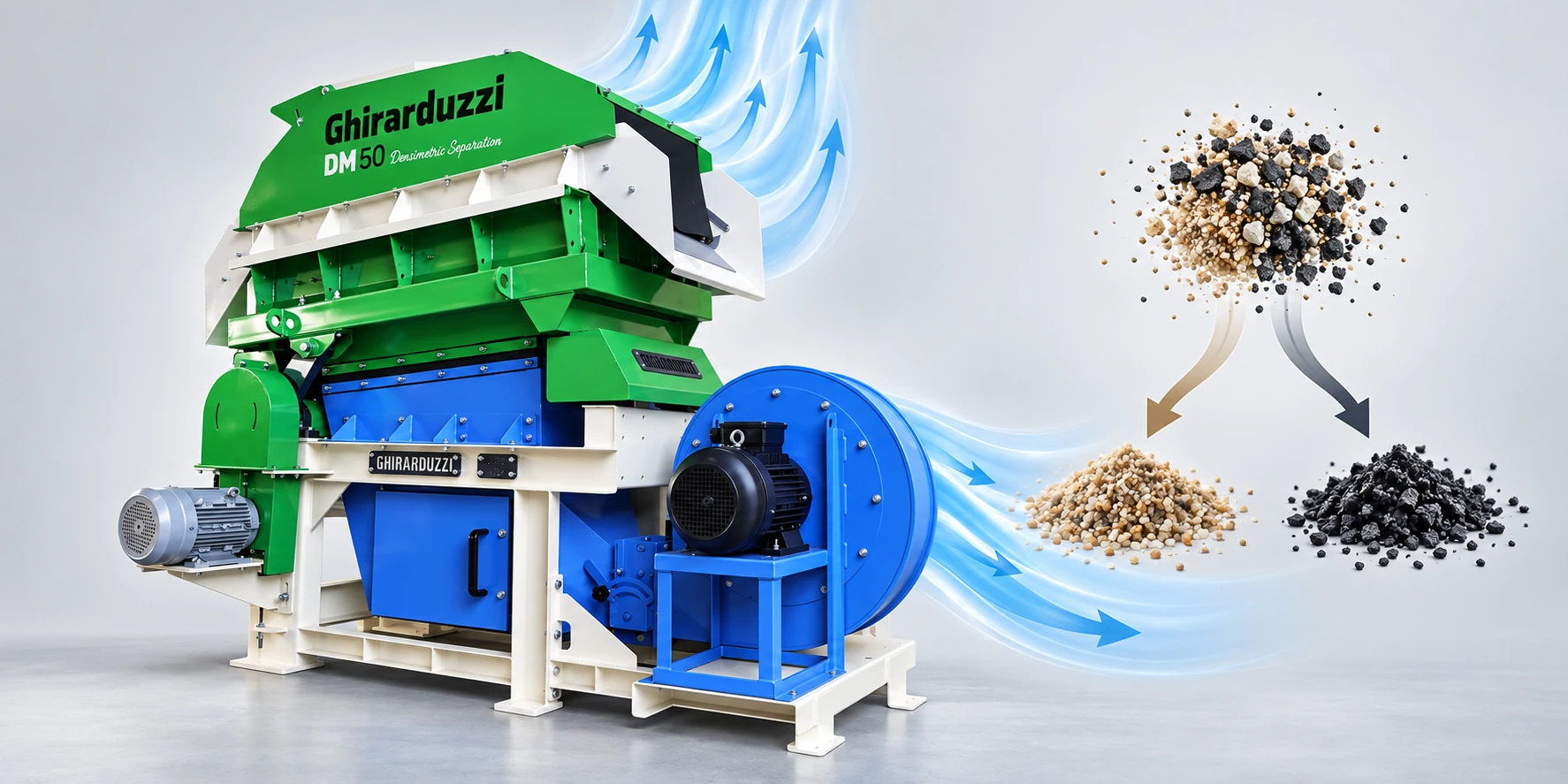
Ghirarduzzi DM50 air density separator
Ghirarduzzi DM50 separator. An illustrative representation of the air separation concept; the arrows do not show the exact technical airflow path.
Your material, our experience: let’s find the right separation solution.
Ghirarduzzi DM series air density separators are designed to separate materials with different densities and recover valuable fractions through a dry process.
Build quality, continuous development and configuration according to the customer’s requirements characterise every solution. We start with the material to be processed and the objective to be achieved: trial results guide the technical choices.
Do you have a mixture that is difficult to separate? Start with a test.
At our premises, we can carry out trials using a representative sample of your material, assess the resulting fractions and identify the configuration best suited to your requirements.
Ghirarduzzi does not simply sell a machine: it works to solve your separation problem.
Contact us to arrange a trial and find out how to prepare your sample.